

Physical AI stands at the crossroads of technological and industrial convergence. Evolving from mere simulation to precise decision-making and control, intelligent agents are transcending the boundaries of the virtual realm to truly embed themselves within—and reshape—the physical world.
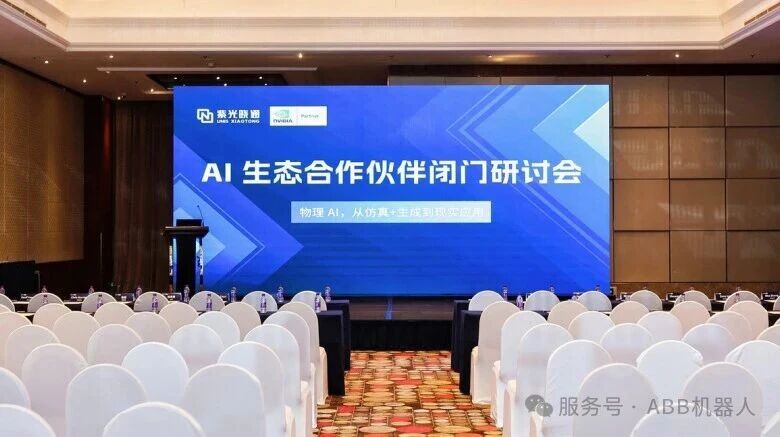
Recently, ABB Robotics was invited by NVIDIA to attend its AI Ecosystem Partner Seminar, where it joined industry leaders to explore how cutting-edge AI technologies can be transformed into tangible productivity that drives industrial transformation.
The event focused on the technical closed-loop spanning “from simulation and generation to real-world application.” As a global leader in industrial automation, ABB Robotics demonstrated to attendees how it leverages NVIDIA’s accelerated computing and simulation platforms to bridge the gap between the virtual and real worlds, infusing industrial manufacturing with “industrial-grade” physical AI capabilities.
“Virtual-Real Convergence”
The Technical Singularity of Industrial Robotics
During the seminar, Yang Yixuan, Global Product Manager for ABB Robotics’ Electronics Business, delivered a keynote speech titled “Seamless Integration of Simulation and Reality: Industrial Robotics Enters the Era of ‘Virtual-Real Convergence’.” She detailed the unique advantages that the convergence of ABB Robotics’ RobotStudio and NVIDIA Omniverse brings to both robot simulation and customers.
Chen Difan, Global Sales and Portfolio Manager for ABB Robotics’ Electronics Business, stated: “The singularity of robotic automation has arrived. Our goal is not merely to make robots smarter, but to ensure that manufacturing enterprises can be confident in their return on investment *before* deploying AI. By reducing commissioning time by up to 80% and development costs by approximately 40%, we are helping customers transform ‘trial and error’ into ‘predictive certainty,’ thereby accelerating the time-to-market for highly complex products.”
Lai Junjie, Vice President of Engineering and Solutions at NVIDIA, commented:
“By integrating NVIDIA’s Omniverse libraries into RobotStudio—a benchmark simulation software in the global automation sector—we have infused ABB Robotics’ unique virtual controller technology with advanced simulation and accelerated computing capabilities. Together with ABB Robotics, we are paving a ‘deterministic’ path toward autonomous production for the global manufacturing industry, while simultaneously redefining the boundaries of industrial automation.”
Deep Technical Integration
The Birth of RobotStudio HyperReality
The collaboration between the two parties is not a simple software adaptation, but rather a profound technical restructuring. For a long time, the discrepancies between the “lighting, materials, and physical collisions” within simulation environments and those of the real world have been referred to as the “last mile”—the final hurdle preventing the practical implementation of industrial AI.
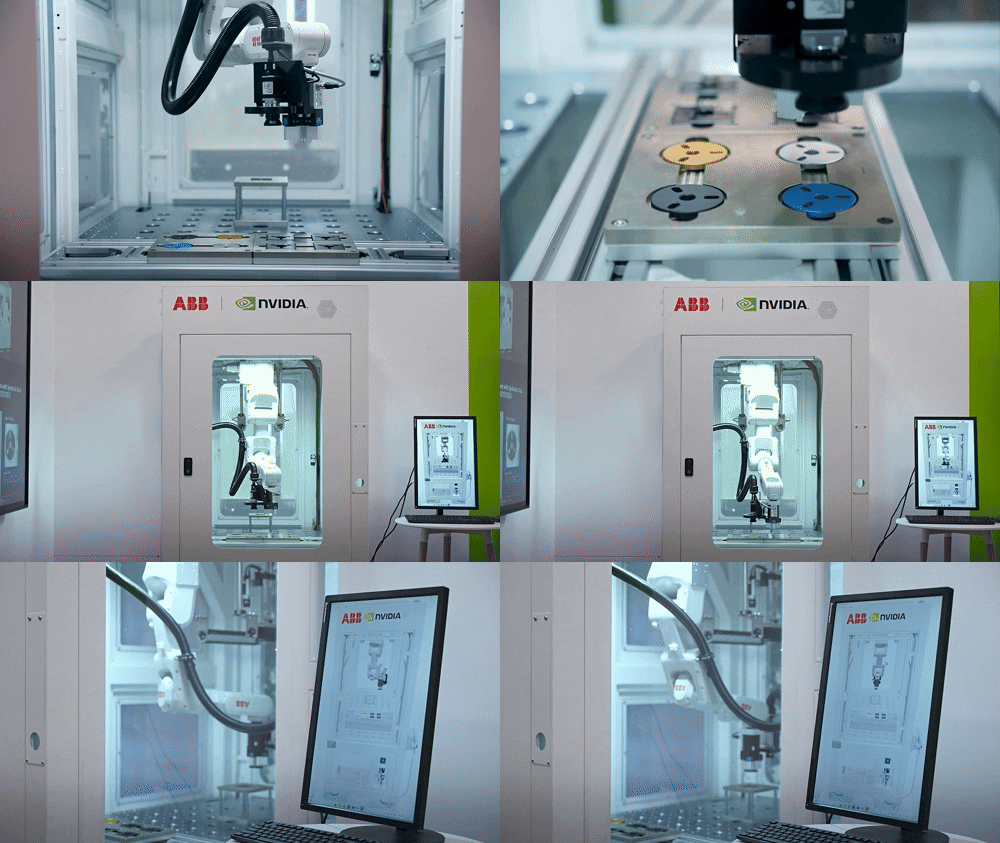
RobotStudio HyperReality achieves a deep integration between ABB Robotics’ RobotStudio and NVIDIA’s Omniverse libraries. Engineers are no longer confined to working solely with cold code and abstract lines; instead, they operate within a digital twin world characterized by physical-level precision and ray-traced rendering.
**How It Works: Core Breakthroughs**
At the heart of RobotStudio HyperReality lies a “trinity” — a multi-layered digital twin architecture that seamlessly integrates the product, the environment, and the robot within a single, unified simulation environment:
**01. Product Digital Twin Layer**
Based on CAD models and manufacturing tolerances, this layer precisely simulates the geometry and material properties (such as surface texture and weight) of the product being assembled, enabling the system to anticipate how it will interact with the real-world product.
**02. Photometric Environment Layer**
This layer provides a high-fidelity simulation of the immediate surrounding environment, encompassing variations in lighting intensity, reflections, shadows, and camera sensor characteristics. It is specifically designed to resolve the critical challenge of “misalignment” that AI vision systems often face when confronted with fluctuating real-world lighting conditions.
**03. Robot Digital Twin Layer**
Encompassing the robot’s mechanical structure, motion capabilities, dynamics, sensors, and control logic, this layer serves to complement and complete the other two digital twin layers.
Bridging the “Simulation-to-Reality Gap”
Through the three layers of collaboration described above, RobotStudio HyperReality achieves two key breakthroughs:
1. Absolute Accuracy Technology: This technology calibrates geometric models based on the robot’s physical configuration, reducing traditional path errors from 8–15 mm to approximately 0.5 mm. This ensures that paths programmed in the virtual environment are executed with equal precision in the real world, thereby meeting the high-precision manufacturing demands of sectors such as electronics assembly.
2. Closed Loop for Synthetic Data Generation and AI Training: By integrating NVIDIA Omniverse’s domain randomization technology, the system can automatically generate vast quantities of perfectly annotated synthetic data for training machine vision and physics-based AI models. This enables the AI to gain extensive “experience” within the virtual production line, allowing it to confidently handle real-world variations in lighting conditions and part tolerances.
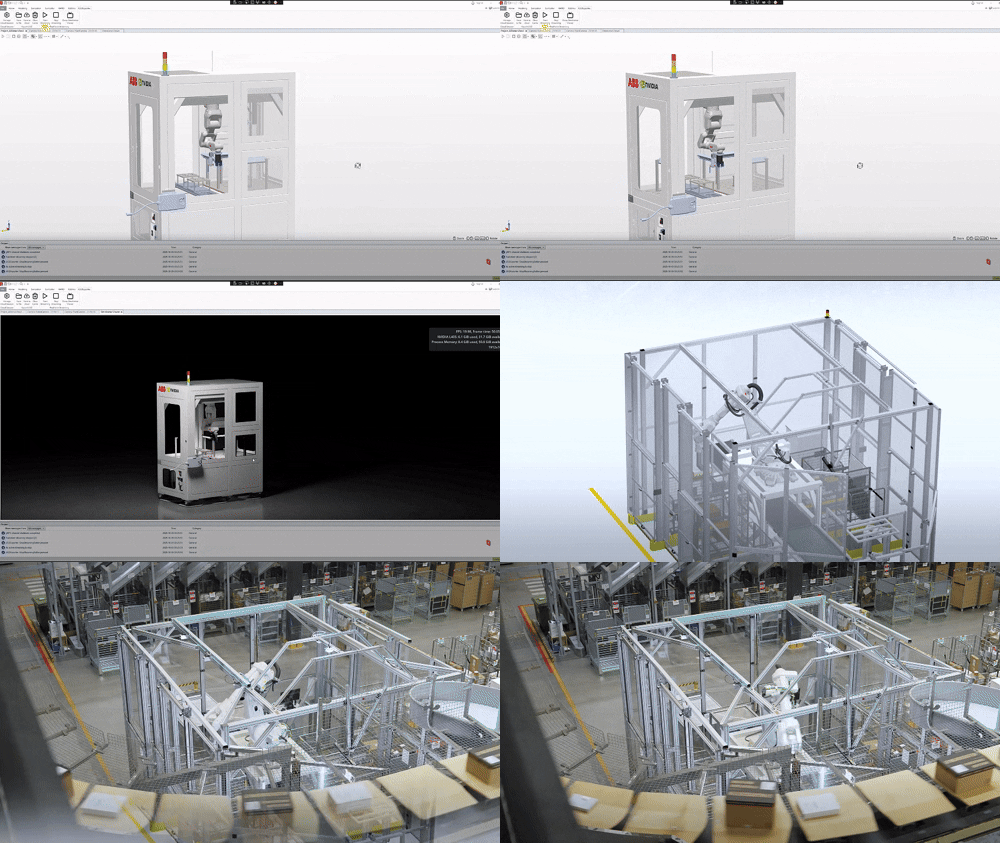
Looking ahead, the boundaries of physical AI will continue to expand. From automotive manufacturing to logistics sorting, and from electronics assembly to data center construction, technologies that bridge the virtual and physical realms are becoming the critical foundation for the manufacturing sector to address labor shortages and achieve sustainable development.
The powerful collaboration between ABB and NVIDIA not only defines a new paradigm for industrial automation but also ushers in a compelling new future for industry—one where every deployment is pre-simulated, and every robot is intelligent by design.